
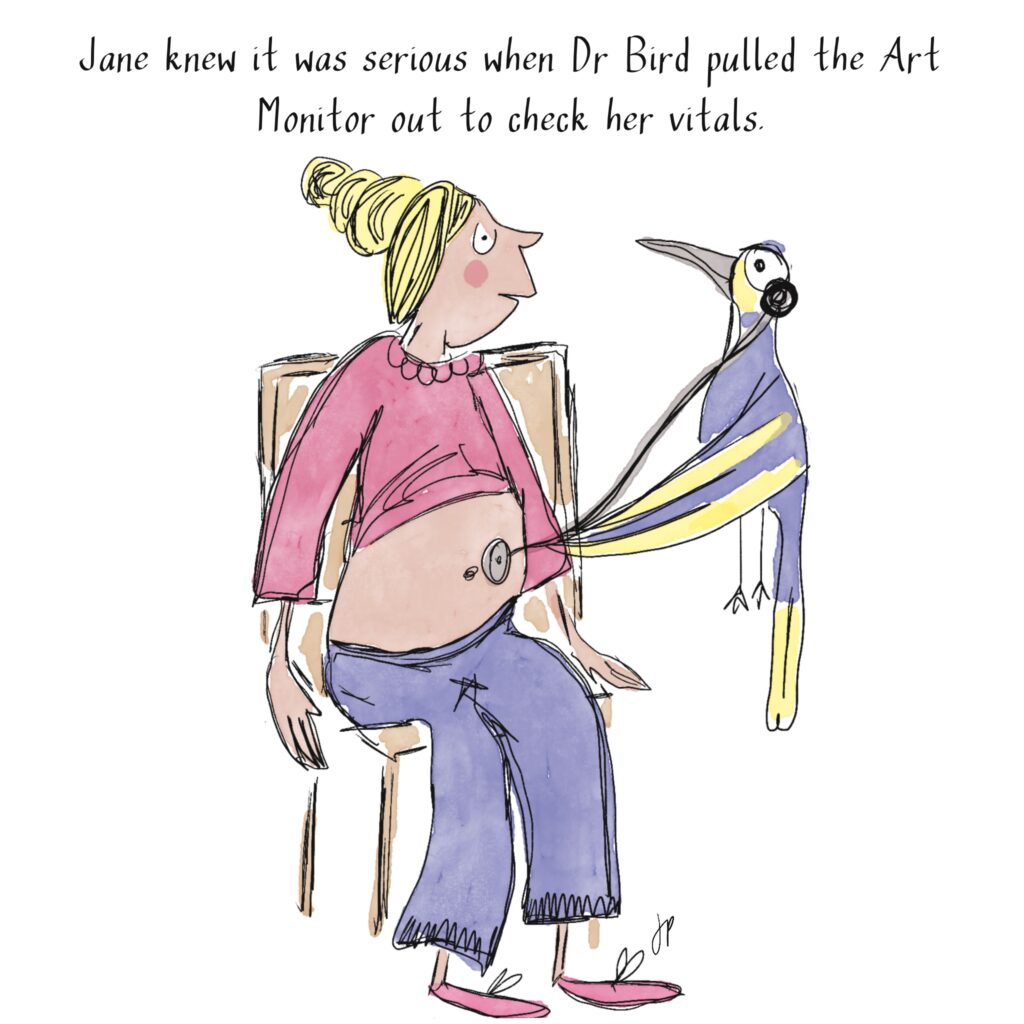
I get a twitchy eye when I hear the words “listen to your body.” I realise this is a blasphemous thing to say—maybe even a confusing thing—coming from someone whose work has been body-based for the longest time. Bodies and brains, bodies and emotions, bodies and nervous systems, bodies and creating… it’s all so body-focused that surely listening to them must be an essential?
Well, yes and no.
If I think about the thing that really derails creative work, it’s not that we aren’t listening to our bodies. It’s that we are but sometimes we’re interpreting what we’re feeling in reactive, obscure or inaccurate ways because the whole “listen to your body” approach relies on two big assumptions:
- an accurate interpretation of your internal experience, and
- a body that’s adaptive and present
… which might not necessarily be the case.
And before we carry on, I want to mention: it’s vaguely ridiculous that we’re even talking about bodies and nervous systems at all, as though we don’t have more than enough to think about already. When this animal body of ours is moving in a world that matches its physiological design, we don’t need to talk about it. When our senses are stimulated; when movement is purposeful; when we’re in a reciprocal relationship with the land we depend on and the creatures we share it with; when we’re part of a community; when we’re not embedded in systems that reduce us to units of production, our nervous system takes care of itself. As it’s designed to. Most of its decisions are automated and unconscious, the flawed assumption being that it presupposes the world around us allows for health.
But when we find ourselves living in a reality that no longer matches the needs of our animal body, well, this is when things go pear-shaped. This is when bodies get pulled out of intuitive, natural ways of being and flung into levels of dysfunction so widespread we start to mistake them for normal.
At this point, simply “listening” isn’t enough. We need to be skilled and discerning conversationalists with our inner experience. And we need chocolate. Preferably dark. (The Lindt Dark Orange is my current fixation but I digress.)
If you’re going to listen to your body, you need to understand what it means to live in a feeling, sensing body that’s fully online. And you need to know how to tell when you’re listening to something real, and when you’re listening to a pattern.
Because knowing the difference may just change your life. (God, did I just say that? So intense. But, still I’ve found it to be true. If it lands a little heavy, let’s just say this instead: the following is something that’s is very useful.)
Before we “listen to our bodies”, we need to understand how our bodies actually work.
To make sense of this, we need to look at the nature of sensation, or feeling. And so we don’t end up tangled in the weeds together, I’m going to break this down into a couple of simple points:
- Your body is constantly rearranging itself in response to your experience.
This rearrangement falls into two broad categories:
Expansion, a physiological opening that occurs when we’re operating from our creative or parasympathetic nervous system, and a state of being where our body is talking to our brain all day long, and contraction, a protective reflex state that occurs as part of a fight flight response.
And when I say rearranging, expanding and contracting, I mean everything—posture, organs, bones, muscle tone, breath, pressure, the whole orchestra. Even the way your body prepares for and creates movement changes.
- We experience these micro and macro reshufflings as sensation.
When something is novel (meaning a internal rearrangment to our inner world that’s new or slightly outside the norm) it captures our attention and we register it as “feeling.”
The important thing to understand here is that sensation itself is neutral. It’s just a sign of something changing. It’s just your body doing what bodies do — adjusting, organising, responding.
The trouble begins when we assume that every sensation carries meaning. Most of the time, it doesn’t. Most of the time it’s simply the physical echo of your system shifting gears, not a message about who you are or what you’re capable of.
This is where emotion, sensation and interpretation start to blur together, and where creative people can get pulled off-course.
Emotion = Sensation + Story (and this is where things get thorny)
Still with me? Excellent. Let’s adventure on.
To understand our patterns, we need to understand emotions — specifically how we come to name them.
The scientific definition of an emotion is a physiological change. There’s nuance in there, of course, but that’s the heart of it.
The psychological definition is a physiological change plus a subjective interpretation. And that second part is where things get interesting, because it tells us this:
Emotions are infused with meaning. They are interpretative. And interpretation is the exact point where we can get ourselves into a spectacular tangle.
We can summarise it like this:
The sensation we feel is neutral — it’s simply the body rearranging itself in response to our nervous system state.
The meaning we attach to that sensation is not neutral. And if the sensation arises from an old patterned reaction — not from the present moment — then the story we attach to it will also be recycled, habitual, and often wildly inaccurate.
This is why “truth speaks the language of sensation” can be misleading for people whose patterned responses are louder than their adaptive ones.
Thought Patterns & Feeling Patterns: What Happens When Both Get Stuck Together?
Every thought you have comes with its own physical blueprint, a way it expresses itself in your body. You could consider this the physical signature of the emotion.
If you’re a human being (which I assume you are), you’ve likely experienced how a particular thought produces a predictable physical response. Maybe there’s a familiar story you play out, a narrative that loops through your head with the reliability of a broken record.
For example, let’s say you often tell yourself, “I’m not good at this.” And let’s say you’ve told yourself that again and again and again. And in response, there is a feeling.
What you’ve created is an equation, a “when I think this, I feel this” response. This is a motor pattern, or a movement pattern, if that feels easier to grasp.
You’re not just thinking — you’re activating a thought–feeling pair. The feeling arrives so quickly and so convincingly that it seems to confirm the thought, but here’s the thing:
If the thought is learned, the feeling attached to it is learned too. Neither is a signal of truth. Both are patterns running on old wiring.
One of my favourite Anne Lamott quotes is this:
My mind is a dangerous neighbourhood. I never go there alone.
And when you recognise this, you’ll also understand:
Not only does your mind feel dangerous in those moments, but your body feels dangerous also.
In part two tomorrow, I’ll show you how these sensation loops might play out in your creative work and why understanding them will change how you start, stick with, and finish the things that matter to you.
In the meantime, here are some questions to play with…
What sensations do you commonly interpret as “dangerous,” “wrong,” or “a sign to stop”?
When you have a familiar self-doubt thought (or something similarly prickly), what’s the familiar feeling that travels with it? Can you recognise this pairing as a pattern?
What sensations do you immediately try to avoid, fix, or make go away?
Happy creating!
xx Jane