
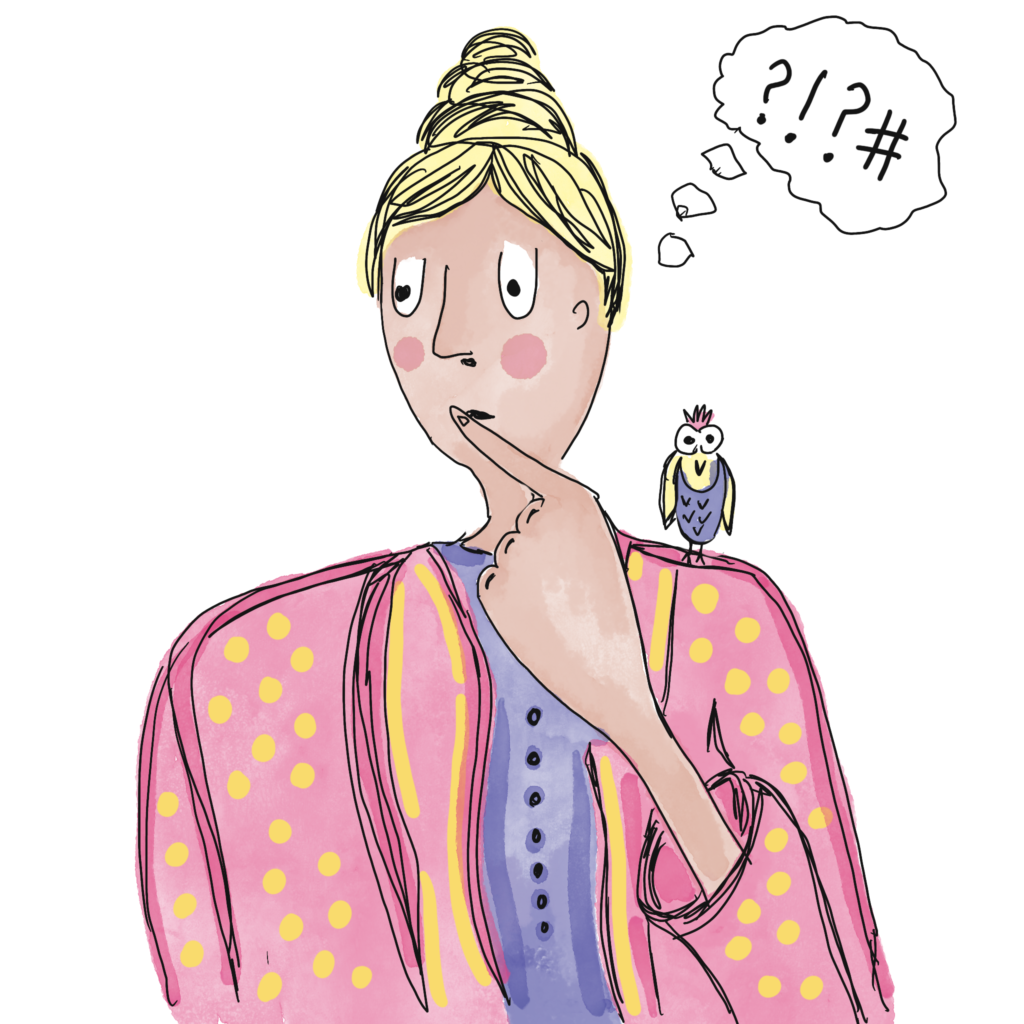
I was determined to write this essay really fast. ‘I’m aware’, I told whatever creative co-conspirators were listening, ‘of the predictable trap of overthinking a piece on overthinking. That is not a stick I will be snaring myself on,’ I said.
But then I got to thinking.
If there’s such a thing as overthinking, there must be underthinking too?
And if overthinking and underthinking sit at opposite ends of the spectrum, what’s the part that sits in the middle?
What’s just the right amount of thinking?
This was obviously something I was going to have to give some thought to. Which, as it turns out, I have plenty of. Thoughts, that is.
Oh god. It’s happening.
The Thing About Thinking
It’s probably a strange thing to say, coming from someone who’s in the business of bodies and how to balance them, but I do love a good think. I’m a very think-ey person. Not all people are think-ey people, but if you are, it’s important that your thinkey-ness gets put to good use. I consider it a Very Valuable Asset.
Because I spend a lot of time involved in brains and bodies and nervous system speak, I’m curious about how intellectual stimulation is never something that is mentioned or included. I believe that us humans, left to our own devices, and not dumbed down by products of our own creation, who convince us they are more efficient and smarter than we, are both infinitely curious and creative.
We wonder. Full stop wonder. At the world. At each other. At our own state of being. And in the ideal circumstances there is space, consideration, exploration for that wonder to be pondered. Our thinkey-ness is satiated by our engagement with the world and the energy it transmits is consumed as an inherent part of that process.
It’s generated, sent out, and then quickly gobbled up as we think, explore and discover. It finds its own balance.
Our thinking becomes weary in the best possible way, because it’s wandered many miles. It’s flexed its muscles climbing trees and wading through rivers. It’s frolicked in rambunctious conversation, occasionally peppered with hearty profanity. Withstood the elements and developed slightly ruddy cheeks. It’s then returned to a warm and comfortable house to eat and drink and sleep.
A good use of thought, wouldn’t you say?
And while this whole bit I just wrote was nothing of what I planned (writing is miraculous like that, isn’t it? You don’t arrive with the answers, you write your way to them. Or something like that) I truly think there’s something in it.
That as a think-ey person, if I spend too much time online or involved in lightweight garbage, letting my eyes and thoughts absorb mental calories full of fillers and sugar and shit, then I short circuit.
That perhaps when my thinking needs are not being met, then they go rogue. A thinking revolt. Revolting Thinking.
‘To hell with her,’ they say. ‘We ride at dawn!’
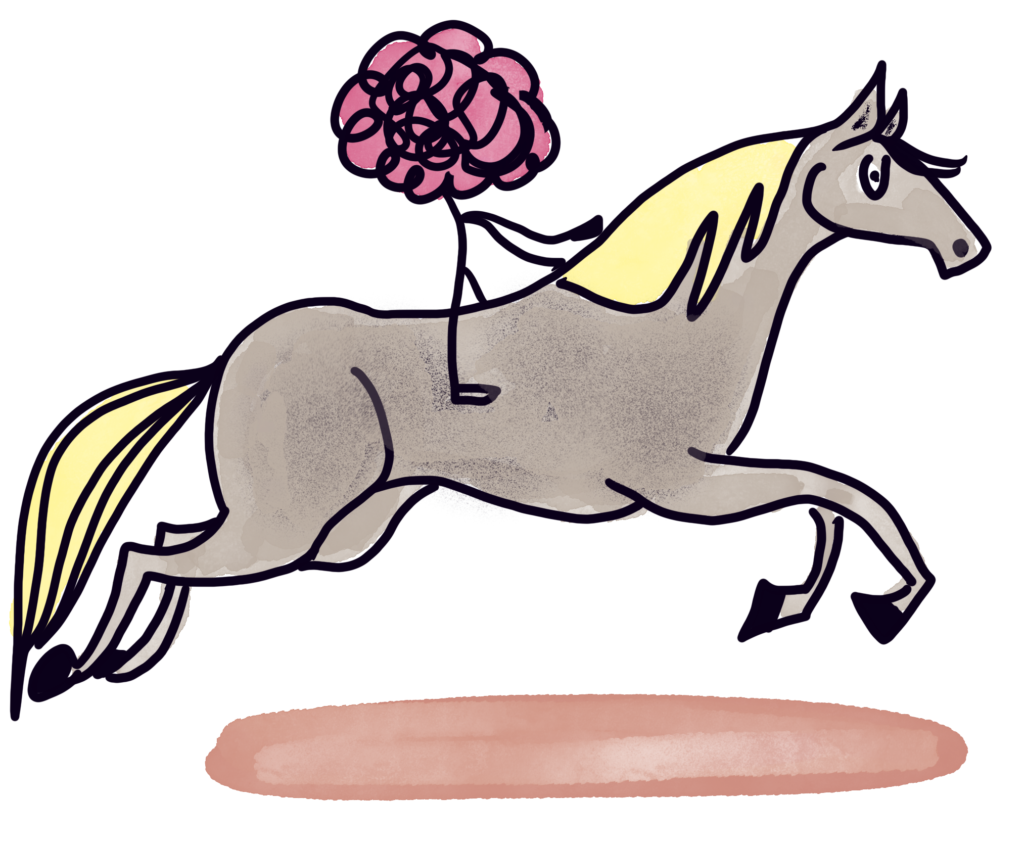
Next minute, I’ve woken up, making a coffee and I look out to see my thoughts galloping down the mountain without me.
‘Where are you going?!’ I yell, but they’ve disappeared behind a tree.
The more I think about it, the more accurate this all seems.
Overthinking As A Product Of Your Nervous System State
Look, we’re still not at the precise overthinking and underthinking part because it turns out my thoughts have a lot to say and there are other things that are important to mention. Or so I think.
One of them is this:
Overthinking is essentially underdoing. Which can both be a product of being already in a fight flight state or pull you into a fight flight state if you aren’t already there. It’s kind of sucky like that.
For example:
A system stuck in a dominant state of freeze will outsource its thinking.
What do you think? It will ask. Can you tell me what to do? What would you do if you were me?
The constant need for advice, to have someone else tell you what to do is a hallmark of the freeze.
Dissociated thinking—where the thoughts are where the body isn’t—is a form of flee. If you find yourself thinking about anything other than where you are, it could be that you are experiencing a dominant state of flight, or it’s been activated within you in response to the circumstances you find yourself in.
These are only a couple of the more common examples, but I mention them because in these instances, overthinking is symptomatic of the foundational nervous system state.
Change that- the freeze or flee template that your body is operating from- and your overthinking tendencies will start to shift too.
Do nothing to shift the foundation and it’s harder to budge the thinking patterns also.
The Other Thing…
Effective thinking (perhaps we could call this “just the right amount of thinking”. See we fell into that, didn’t we?) is a dance between the conscious and unconscious brain that goes something like this:
You make a decision. You take an action. You observed what happened.
This is the conscious part. This is what the conscious brain is in charge of. That’s it.
Following that flow, your unconscious then does what it needs to do to lay down the myelin to smooth out the neural highways and update the motor patterns, so your outcome better matches your intention next time round.
Very boring in print but this is the prescription for all forward progress. What I just described is essentially how we learn.
The problem?
Never decide and you get trapped up in your head. Your brain doesn’t have the sensory data needed from action to make an informed decision about what to do next.
And consequently, you spin around on yourself, with your thoughts having Thought Babies, and they have more Thought Babies, until it’s basically a zoo in there and you can’t tell Jack from Jill, and you become the thinking equivalent of the Titanic. Seems alright for a moment until the ship starts going down.
If there was only one thing you take from our conversation here, it’s that if you find yourself stuck in your head, unsure what to do, the antidote is to take action of any kind.
Just do something.
Anything.
It’s only by taking action that the path you seek will actually appear (I’m sure there’s a fortune cookie or a Lao Tzu or Rumi quote that says exactly that but, in any case, it’s solid).
Thinking & The Creative Cycle

The challenge of ‘The Right Amount of Thinking’ is that the creative cycle itself holds us in a strange paradox.
We need to think long enough to let ourselves arrive at something we could consider to be new and novel thought; to stretch our thinking and marination time just beyond the point that it is comfortable.
Why’s that?
Well, our early thoughts about a project or idea tend to be the most predictable. They are the ‘you say cat, I say dog’ thoughts. The ones where our brain is working to its most predictable connections.
We need to give ourselves long enough to extend past the anticipated and into something new, which is where the conversation around creative capacity becomes so important.
This whole Swimming In The Sea of the Unknown is the essence of the creative process, but it requires that we can stay with ourselves (literally and metaphorically) to midwife whatever creative idea or possibility is waiting for us out into the world. It can be not all that comfortable.
There does need to be an endpoint; the moment where you make the decision on what your focus or direction will be and move into the next stage, but it’s a delicate balance of giving yourself just enough— just enough time to stretch your limits and not so much that your limit twangs, springs back and hits you in the face.
So, When Does It All Become Overthinking?
In two places:
1. When the thinking phase appears to have no end
If what you’re contemplating and undecided on involves a bigger body of work, and you are unsure of the direction to go in or what exactly to commit to, take your most appealing idea and try it out.
Write five pages. Make a series of thumbnails. Sing a few lines. Make some samples.
Whatever your creative medium of choice, commit to a “taster” of the project.
Once you take action, the process itself will inform what needs to happen. It’s the action not the thinking that will work the whole thing out.
2. When how we are experiencing the thinking and ideation phase creates feelings of concern and contraction, rather than possibility
Where we are in danger of overthinking (or falling into not useful thinking anyway) is when the quality of the thinking process changes. When how we experience the thinking is different.
We typically describe overthinking as angst ridden. As thoughts going out of control and ensnaring us in tendrils of our own making. Overthinking is thinking that’s coupled with concern; concern that we might not get it right. That our decision will be wrong. That the end product won’t match up with our intention.
In this case, a process to follow could be:
- Metabolise the feeling. The energy within you needs to move.
- Choose something to make tangible. It doesn’t have to be the thing you ultimately “do”. It’s more about (re)training yourself to take action and making things real, regardless of the outcome.
- Decide the next best half step from that place. What’s the easiest thing to do next? What feels the most exciting or appealing? Make that the thing you do.
And remember, when in doubt do something. Anything.
It’s the only thing that will make the next thing to do clear to you.
Do you struggle with overthinking?
How to do you deal with it in your creative projects?
I’d love to hear your thoughts (ha! An unintended pun. I do love those).
xx Jane