
I’m interested in the stories we arrived with. The words and ideas that are lodged in the clay of our bones. How creativity can facilitate belonging. All these topics swill around the whitewash of my brain.
I have written previously about the idea of creative lineage, positioning through my words, in part, our ancestry as a straight line, but I realised just this morning that my words have been all wrong. That the way I reference things will need to change.
This morning, when I started drawing, I understood:
We aren’t born of direct lines, of mothers and fathers and grandmothers and grandfathers, and all that extend beyond that.
If you trace ancestry in the traditional way, it may appear that way at first, but fairly soon your page will become messy and you’ll start to wonder if we aren’t, in fact, family trees but root systems, some known, some not, all drawing from and returning to the compost of possibility, the seed bank from which everything sprouts and grows.
That there is, in fact, no traceable start points or endings to our existence or belonging.
If we think of ancestry not as a straight line backwards, instead of the spirals and loops that they are, we realise we have emerged in response to a cyclic generosity, held in endless spirals of retreat and return.
Why is this important and not just another play on words?
Because there is no room for kinship within lineage. The idea of lineage itself beds itself in patriarchal beginnings, arising from quests for continued ownership and control.
Kinship, instead, creates belonging, extends its arms well beyond the human.
And what’s more, it is a liberation.
What if there was no lineage of success, or trauma, or joy, or sorrow, but instead a mass, a heap, a fertile dirt from which everything is free to grow?
I have noticed where I have imposed linear thinking, linear words on an earthly existence that is anything but a straight line. Everything that is real around us and within us moves in cycles. The days, the seasons, the planets.
We did, at one point in time, understand that we do not own the land. We belong to it. This is our true inheritance. Perhaps if we let go of the idea of lineage, belonging is easier than we think.
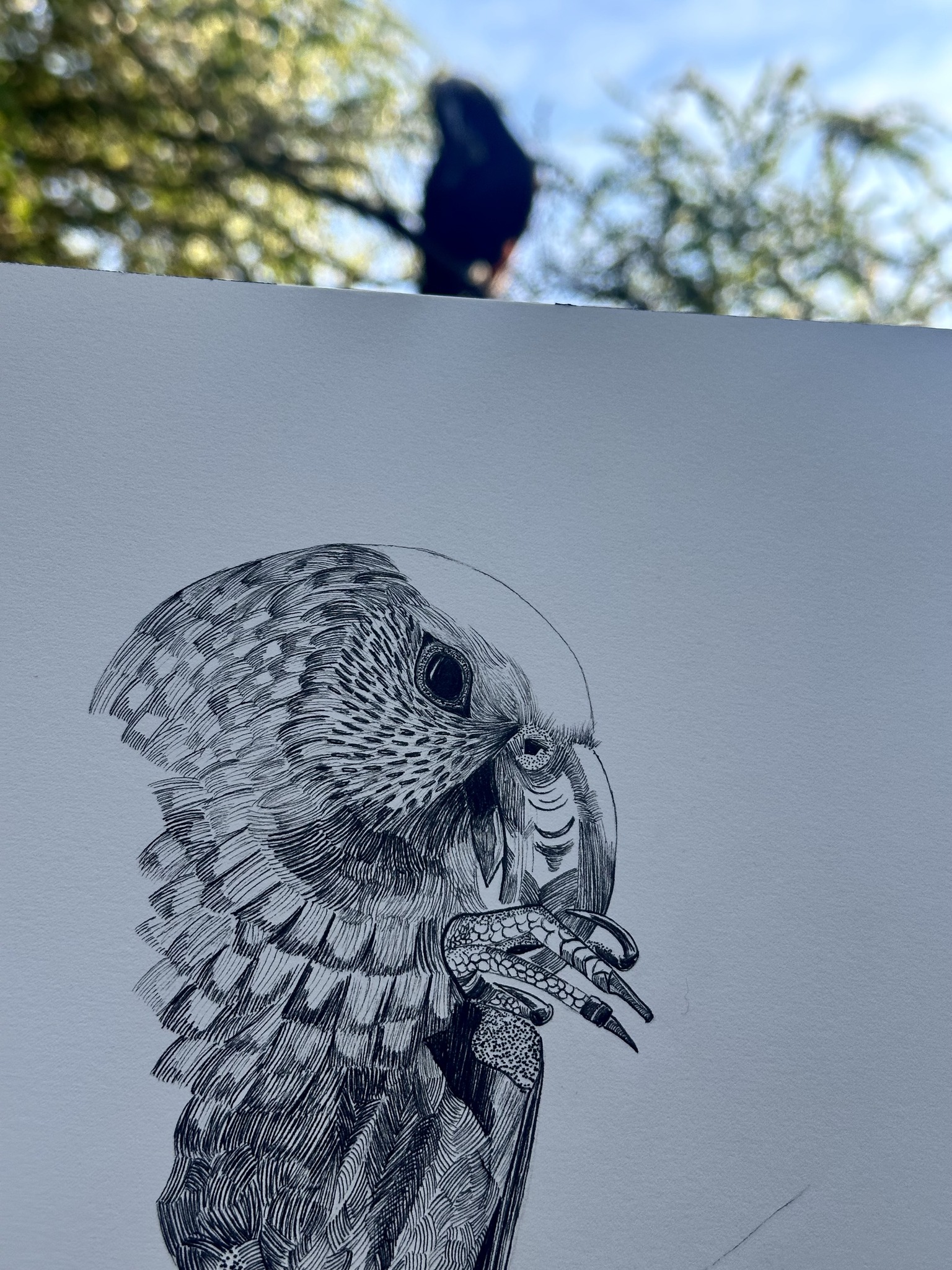
I know drawing for me is about kinship. My birds don’t belong to me, but it delights me to think that I belong to them.