
I’m afraid there’s nothing I can do. This will be a total waste of your time. You should probably get up and leave now. It’s useless. You can’t say I haven’t tried.
I’ve taken The Words for a walk and instructed whatever part of my brain is responsible for finding them to listen up:
I’m going walking, I say. You should think about perfectionism. You’ve got an hour. Then, we will write.
Between me and The Words are multiple cups of now-cold, undrunk tea. I’m stuck somewhere between wanting to escape—run, do anything, go anywhere other than here—and feeling like I’m moving in slow motion. I end up doing neither, suspended in a place of no-motion.
I’ve cried. Can you believe that? Actually cried. Over what, I’m not exactly sure. My cheeks are hot, and I’ve distracted myself a million times. I do have Words: These Words, Those Words, All The Fucking Words crawling out through the spaces in my skin but they aren’t the ones I want. They’re never The Right Words.
I know this beast. And she’s eating me alive.
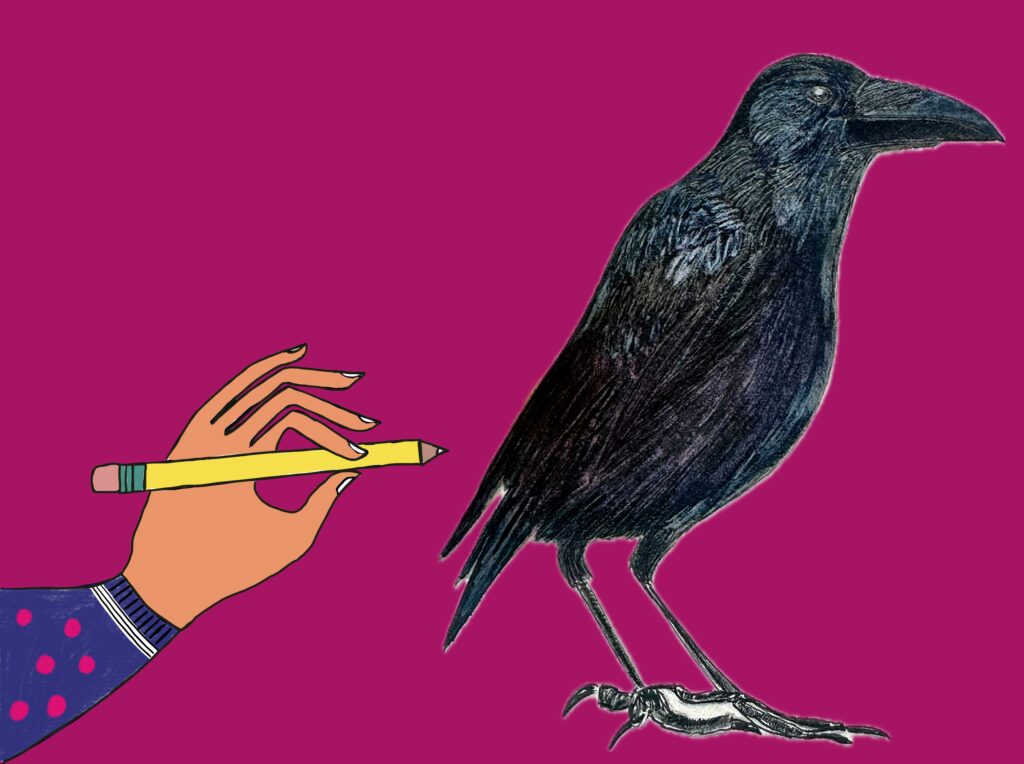
I watched a student of mine the other day, sitting in the corner, trying to draw a bird. She has three degrees, she tells me, and one of them is art. The second is design, because the art never turned out the way she wanted it to. The third is economics because, well, she needed to make a living. So it goes.
Now she’s here, drawing a bird—and her bird is good, excellent in fact—and she’s convinced she cannot do it. That it’s no good. This, she declares, is why she doesn’t draw much. It never comes out the way she wants it to. It just never works out on the page.
I feel the gripping of her insides in my own and cannot stand it.
I had something different for you—a whole finished piece about perfectionism that was quite neat and nice—but I thought about my bird-drawing-art-person-friend with three degrees and I knew it wasn’t right. It wasn’t truthful in the way it needed to be. It wasn’t a conversation about aliveness, which is what this is. So, let’s be truthful, shall we?
My perfectionism may be something I’ll never be quite rid of. She rises like the hunger that she is, catches me off guard and then consumes me. I’d love to tell you I’m graceful in those moments, but that would be a lie—and we’ve already agreed not to tell lies. I might be wiping tears away, grit spitting out between my teeth but I am fierce. I claw and scratch and let my face distend. I’m not interested in niceties or politeness, in beautiful words or the right phrases. Perfectionism is a life-reducing tyrant, and I’m in this to survive.
There’s nothing natural about perfectionism, this I know. It’s not a personal quirk; it’s a learned mechanism of control that keeps us small, compliant, and endlessly self-correcting. It’s internalised oppression dressed up as self-improvement. It’s what happens when the systems we live in—patriarchy, capitalism, white supremacy, ableism—convince us that our worth is conditional on performance, productivity, and presentation. So we absorb those values into our nervous systems and call them “standards.”
Perfectionism becomes oppression when our own nervous system becomes the enforcer. We start policing ourselves. The inner critic is the coloniser within the psyche, an internalised voice of the systems that reward suppression and control over authenticity and spontaneity.*
I think of the words of Anne Lamott :
“How alive am I willing to be?” And if you’re willing to be really alive, then you’ve got to write your truth. You’ve got to tell your stories. You’ve got to do this deep union with self, or you have to ask yourself, “Why am I even here? What’s the point?”
And while I want to tell you some things that have helped me that are more practical and mundane, I’ll start with the most necessary of all: a healthy dose of fire. A fire that reminds me I will not be taken down. That I will not succumb to those voices. That I will use mine to spark the flame in others too. That I will write all the words, my words, all the wrong and clunky and terrible words when the beautiful ones elude me and I will draw all the lines that are not quite right or in the wrong places, or upside down, all the birds that don’t look like birds.
And what’s more I’ll be gleeful. And I will do it loudly, and joyfully and (ir)reverently and I will do it over, and over and over and over and over.
And you will join me and we’ll eat cookies, and drop the crumbs over the floor, and we will grab pencils and make big marks across the sky and we’ll remind ourselves of this full bodied dance that is creating.
Because we are a human, doing the things that humans do.
Making and creating. Wildly, freely, frequently.
To accept anything different is the lie.
xx Jane
*Attribution Note:
These ideas sit within a broad lineage of feminist, anti-capitalist, and trauma-informed thought that understands perfectionism not as a personal failing but as a learned system of control. Writers such as Audre Lorde, bell hooks, Anne Lamott, Brené Brown, Sonya Renee Taylor, Tricia Hersey, and Resmaa Menakem have all, in different ways, explored how domination-based cultures teach us to internalise surveillance, self-correction, and worthiness through performance.
The phrasing here is my own synthesis, but the roots of it are collective, drawn from a long conversation about how systems of patriarchy, white supremacy, ableism, and capitalism shape our nervous systems and our sense of worth.