How To Outsmart Your Inner Perfectionist

A few days ago, I had a good wail about perfectionism and how it can turn us into human turnips. I wrote that piece because I’d read an article where perfectionism was framed as something cutesy with a Hello Kitty vibe. A kind of hands-in-the-air rally cry for the perpetually-trying-to-be-perfect, as though waggling your finger and telling someone to loosen up would be enough to encourage them to pull on their roller skates, let their hair down, and get over themselves. Or something like that.

It felt important to say that if you struggle with perfectionism, it’s not your fault. It’s part of a system of control we’re trained into. And even though this is unfair, and sucks, and we should all sit around drinking coffee and gesticulating wildly about what a load of rollicking bollocks it is (side note: I would like that very much. Call me.), we can’t escape the fact that if we find ourselves afflicted by the perfectionism gremlins, it’s our responsibility to shake them off. We have to take our own hands and lead ourselves to the other side.

And don’t think I’m telling you this from theory—I’ve cross-trained in the highest form of energy a body can produce without chemical assistance: perfectionism and panic combined. And despite those things, if there’s something I’d happily toot my own horn about, it’s that I am a pro-level action taker. I’m really, really good at getting things done. If I’m inspired, have an idea, or want to do something, I’m doing it as soon as yesterday. I believe I can do it, and if I can’t yet, I’m convinced there’s a way. I don’t know where this self-belief came from, but I’m grateful to her.

Action, I’m convinced, is the elixir. An astonishing, repetitive, mildly nauseating dedication to literally doing The Thing. It’s really as simple (and as complicated) as that.

With that in mind, let’s adventure on. If we were to summarise the “problem of perfectionism” in a creative sense into a single point, it would be this:

Perfectionism, in practice, is either a problem of starting or a problem of finishing.

Let’s look at both.

The Problem of Starting

Perfectionism is a starting problem because that glistening idea in your brain never seems to materialise the way you want it to when it lands on the page. Somewhere between your head and the paper (or the computer, or whatever your chosen surface), it gets stuck at the traffic lights on a highway that’s always under construction.

You find yourself deleting more words than you write, erasing more lines than you draw, and wallowing in a frustration that soon feels too big for your skin to contain.

I’m not going to sit here and tell you to “focus on the process” or “not worry about making something good,” because that kind of advice will just make you want to hurt me.

Instead, I’m going to tell you this:

Focus On Quantity Instead Of Quality

We’re going to shift the compass slightly. Instead of aiming for the perfect paragraph or the drawing that turns out exactly the way you imagined, you’re going to give yourself a quantity goal. You’re going to commit to loads of art.

A drawing a day. A thousand words a session. Whatever fits your form of expression.

We need to keep the gremlins busy but distract them with new goals. And weirdly enough, if we can do that, keep an open mind to learning, and pick up some skills along the way, the quality starts to take care of itself.

The Problem of Finishing

Now we get to the other end of the spectrum: finishing.

If you’ve spent time on a piece or project and find yourself swimming in the sea of “just one more thing”—one more edit, tweak, or stroke of paint—you’re going to have to give yourself a deadline and decide when it’s enough.

Too many unfinished things eat us alive. There’s a liberation in ending.

We leave things open and undone as a “just in case” policy. In case we can make it better. In case we think of a different way to end it.

But end it you must. Draw a line in the sand and finish The Thing.

I’m actually quite obsessed with this idea of finishing energy. I’ve noticed how many half-done things linger in my mind and how consuming they are—how they create a particular kind of fatigue from holding so many things “open.”

And when we think of finishing, it’s important not just to think of bigger projects, but to commit to acts of finishing every day. To become heroic micro-finishers, dedicated to mindscapes like open pastures and forests rather than battery chicken farms.

Following Your Own Instructions (Otherwise Known As Exporting Your Perfectionism)

What you’ll be left with now is a conversation with your body. When you sit down to do The Thing—or finish The Thing—and your perfectionism gremlins get activated, it’s going to show up in your body in a very specific way. One you’ll recognise.

“Ahh,” you’ll say. “Here we go again.”

That feeling will be seductive, so take this as your warning. It will try to convince you to discard everything we’ve talked about and return to your familiar patterns. There will be comfort in that—not because it’s what’s best for you, but because it’s what’s known.

So here’s what you must do:

Decide on your quantity goal, and decide in advance what “enough” will be. Decide when you will finish.

Be humane with yourself. These goals are not for beating yourself up—they’re scaffolds to help you create something new.

Write them down, and then follow your own instructions. Outsource your brain to your written list. Ride shotgun with the gremlins if you must (and you probably will). Pause. Take a break if you need to. But then get going.

Just go and do The Thing.

And you know what else?

You don’t need to be brilliant.

A friend said this to me when I confessed I wanted to write more about the nervous system and creativity but was afraid of being morbidly boring—of slipping into the lingo of my training in a way that wasn’t useful.

I don’t need to be brilliant. But I do need to show up and do the work.

And if that remains our key directive, the beauty is that—in whatever way it fits into our own lives—it’s something we can all absolutely do.

To your glorious, imperfect selves,

xx Jane

PS. I’m serious about the coffee.

Ironically, I’ve Written This Essay On Perfectionism Twice.

I’m afraid there’s nothing I can do. This will be a total waste of your time. You should probably get up and leave now. It’s useless. You can’t say I haven’t tried.

I’ve taken The Words for a walk and instructed whatever part of my brain is responsible for finding them to listen up:

I’m going walking, I say. You should think about perfectionism. You’ve got an hour. Then, we will write.

Between me and The Words are multiple cups of now-cold, undrunk tea. I’m stuck somewhere between wanting to escape—run, do anything, go anywhere other than here—and feeling like I’m moving in slow motion. I end up doing neither, suspended in a place of no-motion.

I’ve cried. Can you believe that? Actually cried. Over what, I’m not exactly sure. My cheeks are hot, and I’ve distracted myself a million times. I do have Words: These Words, Those Words, All The Fucking Words crawling out through the spaces in my skin but they aren’t the ones I want. They’re never The Right Words.

I know this beast. And she’s eating me alive.

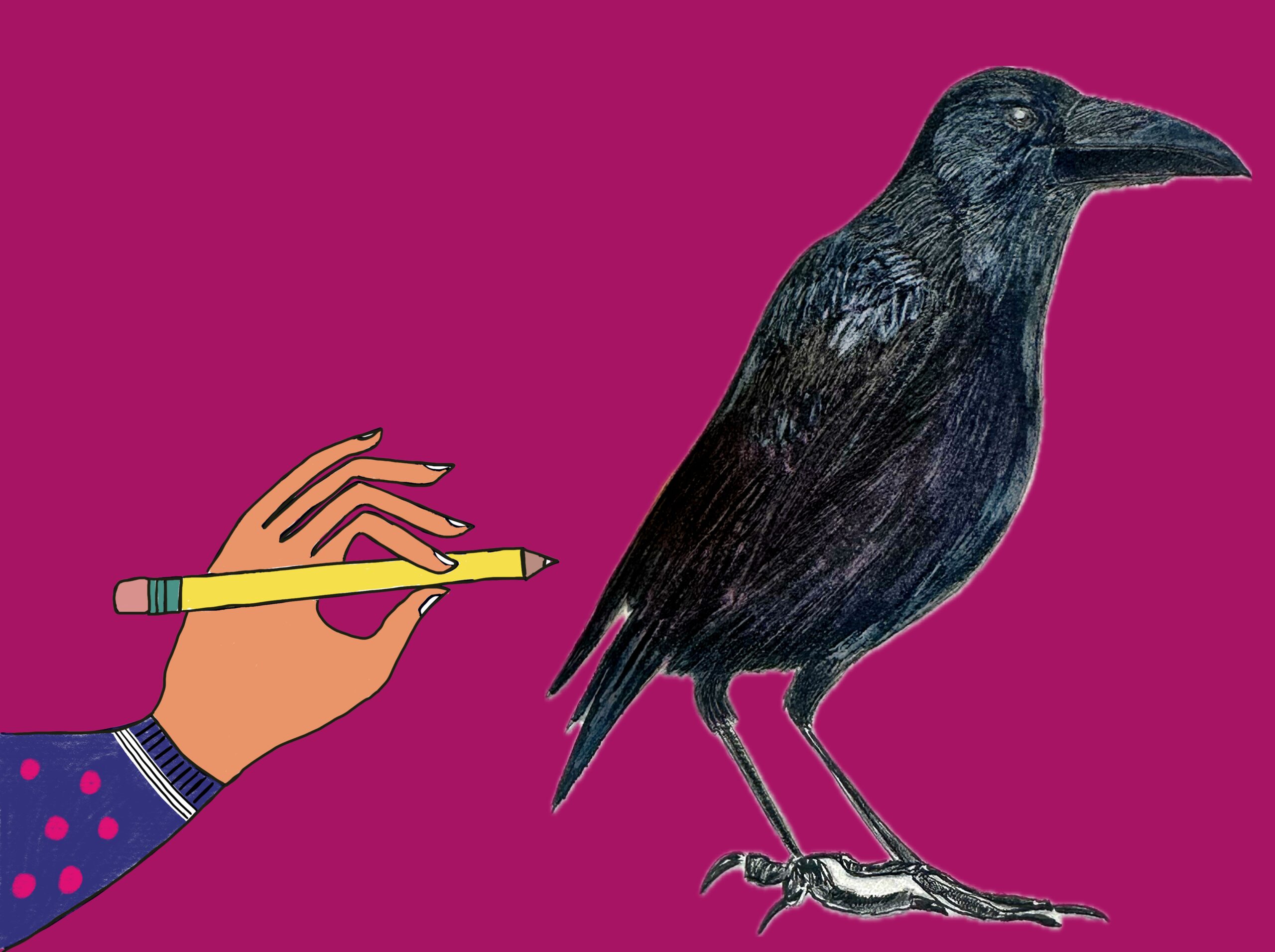
I watched a student of mine the other day, sitting in the corner, trying to draw a bird. She has three degrees, she tells me, and one of them is art. The second is design, because the art never turned out the way she wanted it to. The third is economics because, well, she needed to make a living. So it goes.

Now she’s here, drawing a bird—and her bird is good, excellent in fact—and she’s convinced she cannot do it. That it’s no good. This, she declares, is why she doesn’t draw much. It never comes out the way she wants it to. It just never works out on the page.

I feel the gripping of her insides in my own and cannot stand it.

I had something different for you—a whole finished piece about perfectionism that was quite neat and nice—but I thought about my bird-drawing-art-person-friend with three degrees and I knew it wasn’t right. It wasn’t truthful in the way it needed to be. It wasn’t a conversation about aliveness, which is what this is. So, let’s be truthful, shall we?

My perfectionism may be something I’ll never be quite rid of. She rises like the hunger that she is, catches me off guard and then consumes me. I’d love to tell you I’m graceful in those moments, but that would be a lie—and we’ve already agreed not to tell lies. I might be wiping tears away, grit spitting out between my teeth but I am fierce. I claw and scratch and let my face distend. I’m not interested in niceties or politeness, in beautiful words or the right phrases. Perfectionism is a life-reducing tyrant, and I’m in this to survive.

There’s nothing natural about perfectionism, this I know. It’s not a personal quirk; it’s a learned mechanism of control that keeps us small, compliant, and endlessly self-correcting. It’s internalised oppression dressed up as self-improvement. It’s what happens when the systems we live in—patriarchy, capitalism, white supremacy, ableism—convince us that our worth is conditional on performance, productivity, and presentation. So we absorb those values into our nervous systems and call them “standards.”

Perfectionism becomes oppression when our own nervous system becomes the enforcer. We start policing ourselves. The inner critic is the coloniser within the psyche, an internalised voice of the systems that reward suppression and control over authenticity and spontaneity.*

I think of the words of Anne Lamott :

“How alive am I willing to be?” And if you’re willing to be really alive, then you’ve got to write your truth. You’ve got to tell your stories. You’ve got to do this deep union with self, or you have to ask yourself, “Why am I even here? What’s the point?”

And while I want to tell you some things that have helped me that are more practical and mundane, I’ll start with the most necessary of all: a healthy dose of fire. A fire that reminds me I will not be taken down. That I will not succumb to those voices. That I will use mine to spark the flame in others too. That I will write all the words, my words, all the wrong and clunky and terrible words when the beautiful ones elude me and I will draw all the lines that are not quite right or in the wrong places, or upside down, all the birds that don’t look like birds.

And what’s more I’ll be gleeful. And I will do it loudly, and joyfully and (ir)reverently and I will do it over, and over and over and over and over.

And you will join me and we’ll eat cookies, and drop the crumbs over the floor, and we will grab pencils and make big marks across the sky and we’ll remind ourselves of this full bodied dance that is creating.

Because we are a human, doing the things that humans do.

Making and creating. Wildly, freely, frequently.

To accept anything different is the lie.

xx Jane

*Attribution Note:

These ideas sit within a broad lineage of feminist, anti-capitalist, and trauma-informed thought that understands perfectionism not as a personal failing but as a learned system of control. Writers such as Audre Lorde, bell hooks, Anne Lamott, Brené Brown, Sonya Renee Taylor, Tricia Hersey, and Resmaa Menakem have all, in different ways, explored how domination-based cultures teach us to internalise surveillance, self-correction, and worthiness through performance.

The phrasing here is my own synthesis, but the roots of it are collective, drawn from a long conversation about how systems of patriarchy, white supremacy, ableism, and capitalism shape our nervous systems and our sense of worth.

Creative Re-Entry: How To Start Again When It’s Been A While

So here’s the question:

“I used to paint and enjoyed how time passed unnoticed while I was daubing away. But for some reason I stopped, and now it’s been years and I simply don’t know how to start again—or if I even want to paint at all. I do want to make messes of some sort, though!”

I feel it’s necessary to start with a little celebration.

I’m objectively a terrible dancer—no shade to self intended, it’s just the truth. I have a window of about ten seconds where I use up all my moves and then end up involved in some complicated swaying. But right now, I’m dedicating that full ten seconds just to you.

Because I think it’s important to remember there are two types of problems.

Problems that are, in fact, problems.

And the other sort, which are what we might call Very Good Problems To Have.

And this problem—the one that asks how we might use our creative energy again, even when we’re not sure how or in what form—is A Most Excellent, Very Good Problem To Have.

So let’s start there. With the enthusiastic embrace of this excellent problem. It allows us to proceed with a different sort of lightness.

Now, we can become creative sleuths.

The Problem of Inaction

We can probably agree that the solution to wondering where to start is just to start anywhere. You just have to begin.

That looks very good on paper and makes perfect sense when written down but for some strange and mysterious reason, it’s not that easy in Real Life.

One of the key parts of The Problem is this:

We think that if we just think about it long enough, eventually we’ll arrive at The Best Place To Start. That we can think our way to the Best Beginning.

This isn’t entirely our fault. We live in a world that loves to analyse and to question, and we’ve become skilled in overthinking and underdoing as a result.

But the key really is to do something—anything—to begin. That something may not be what you end up doing regularly or devoting yourself to, but it’s a Necessary Something to get to the thing that is.

Your brain is dedicated to all things practical. It only knows the next step it wants to take when it can observe something real—something it can see, smell, taste, or touch.

Then it’s able to assess and decide where to go next: whether to continue, to tweak, or to abandon.

The key is not to stay in your head too long. Sooner rather than later, you need to commit to making something—anything—real. It’s the only way to find out what happens next.

Once you’ve realised that “do anything” is the first step to starting again, we can move to the next one.

You have to let yourself have the experience of starting again

It might sound ridiculous, but it’s true. You haven’t done this for a while, given yourself time for your creativity. To be creative is to step into the unknown.

Take your whole self with you. Let yourself be in this place, the place of a person figuring it out and starting again.

Don’t be surprised by what comes up when you meet yourself there: that it feels strange or clunky, that you’re not sure what you’re doing, that you feel frustrated.

Of course you do—you haven’t been here for a while. Don’t let those feelings convince you you’re doing something wrong.

Here’s another thing that’s helpful to know:

Writing, drawing, painting (literally anything) is a movement pattern (at least from the perspective of your nervous system and brain), just like riding a bike, surfing, or running.

If you haven’t done those things for a while, you don’t expect to be a pro straight away. You might laugh at your lack of coordination, but you also understand the only way to get better is to keep going. That it just might take some time.

Creating of any sort is the same, we just come at it with a much more rigid perspective. We somehow think about it differently. But essentially, it’s identical. You have to grease those neural pathways, drop yourself into your creative brain (even if it takes a while to find it).

You have to give yourself enough grace to have the experience of starting again.

Where to start?

With whatever piques your curiosity.

If you look at something and think, I’d love to be able to do that, or that looks fun, start there.

You don’t have to be brilliant (a friend said this to me recently and I found it incredibly liberating).

Follow Your Curiosity Into Action

I’ve become a little bit obsessed with following my natural curiosities into action as and when the impulse arises (or as close to), instead of deferring it to some point in the future.

We’re trained from a young age to follow schedules that tell us when to eat, move, and rest. Over time, we become schedule-led instead of body-led, and then we wonder why we feel disconnected from our instincts in other areas of life.

The same pattern shows up in our creative lives. We think it would be better to wait until we have a big chunk of time, the perfect setup, or a fully formed plan—hello, control patterns and perfectionist tendencies—but what if we stopped waiting for the conditions to be ideal?

If you feel that spark of curiosity or movement inside you, act in service of the impulse, even in the smallest way. Don’t wait for the future to make it easier. It rarely does.

And if you can’t act in that moment, at least notice it. Then, as soon as you can, make a movement in that direction.

Hang Out With People Who Do The Thing You Want To Do

There are two things we’re missing, as human people in this world:

First, communities of makers who normalise that making art is a necessary and important thing to do.

And second, places that help us take action—that help us translate longing or ideas into actually sitting down and doing the thing.

I have a creative membership called Creating Wild that focuses on exactly this, so I can speak from experience: it is transformative.

I’m not saying join my thing (although you’re absolutely welcome to). What I am saying is: find your people. Hunt them down with creative ferocity, in whatever way is available to you. You’ll be thankful when you do.


If I could pull you aside now and offer some parting words, they would be these:

That inkling you have—that thought about painting again, or creating again—it means something. It counts for something.

Let yourself follow it, and trust that you already have enough within you to figure it out as you go.

So start where you are. With the tools you have, the time you have, and the curiosity that have realised never left you. That’s all you need to begin again.

Happy creating!

xx Jane

Who Even Cares? A field guide to creating when it all feels a bit pointless.

Before we get started, you should know that I have a pathological fear of being boring. Flaccid is another word I also never want anywhere near my name (even just writing it makes me screw my nose up). And alongside them, I’m going to throw in apathetic, that chronic Feeling of Blah Blah Blah.

It’s not that I’ve never dealt with the Blah Blahs. Of course I have. It’s part of being human. But working with so many people navigating very grown-up things like “regulated nervous systems” (or the quest for one), I see more fabulous souls than I’d like struck down with cases of the Creative Blah-Blahs when they need not be.

And being so resistant to the condition myself, if you identify with The Blahs in any way (or, in fact, feel that way right now), I feel it’s my duty to perkily—and possibly somewhat irritatingly—see if we can’t navigate our way out of it together. I can also use everything that follows as a note to self.

I mean, who cares? Why does it even matter?

So, we’re here are we? Nursing those old chestnuts. I didn’t want to use the example I’m about to for the simple reason that I personally never get sick of drawing birds but seeing it’s the first thing that popped into my head, we’re going to run with it. A cosmic joke, if you will.
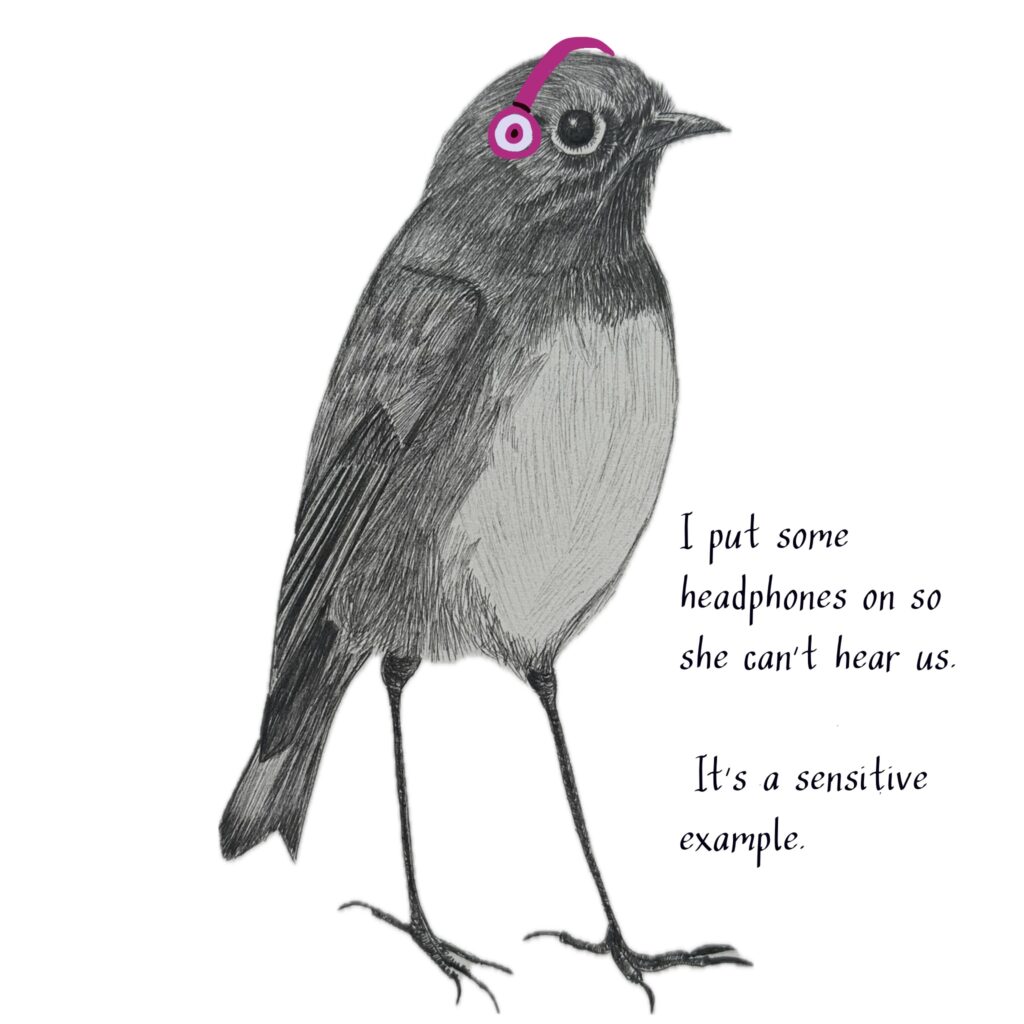
Let’s say you’re on a quest to draw more birds (but it could just as easily be writing a book, making more art—insert your thing here). You’re sitting down at the table. There’s a million things you should, could, and don’t want to be doing. Work to be done. Messes to be tidied. All the many things clawing at your attention.

And even though you don’t actually want to be doing those things—you do, weirdly, want to be here drawing birds—you still find yourself wondering what the hell you’re actually doing.

You look down at your paper and convince yourself it’s crap. I mean, it’s actually kind of embarrassing that you’re doing this at all. In what universe did this seem like a good idea? It’s not like you’re ever going to sell them, and even if you wanted to, you’d probably make no money.

You’re pretty sure you’re not good at it—I mean, look at it—and anyone who tells you differently is probably just being kind. God, what’s actually the point?

Well, I’m so glad that you asked. This is the perfect question to pick up on:

What really IS the point?
I can’t assume to know what the point is for you (although I have an inkling), but I want you to sit with this question for a moment. Just watch your tone—the emphasis you use will change how you answer it completely.

What I can tell you is what the point is for me: without art-making, I am bonkers. Without art-making, I am sad. Without art-making, I am irritable and grumpy and feel like I have things (I don’t know what things exactly—things) wanting to escape out through my skin.

And while we’re on the subject, I also believe that art-making is not an indulgence or a luxury or even something you squeeze in. It’s a function of wellbeing. We are wired to make things. It’s one of the essential considerations of health that needs to be nailed back on the chart alongside your five-a-day and ten thousand steps.

If you consider yourself a creative human (and I’ll assume you do, because, well, here you are), you’ll know that creative energy needs to be metabolised. It has its own urgency and persistence; it doesn’t just disappear.

It has to go somewhere. It wants to turn into something. It needs to move through you.

And if it’s ignored, dishonoured, or disrespected, it doesn’t just evaporate—it comes at you sideways. As resentment. As irritation. As anger.

The long and the short of it? Best sit down and draw that bird.

So, what’s the way in?

Ok, we’ve arrived at a good point. We’ve decided that creating is important and the Blahs are boring and we’d quite like to feel something different.

There are two roads we can take. We can start in the Human Head Area and consider how our thinking might be a co-conspirator in the Blah Blahs, or we can look to this feisty animal body of ours and work out how to twiddle the gears a bit.

Let’s start in the human head area and work our way down.

Human Head Business & The Blahs

All thoughts are a conversation with gravity.

That might sound weird, but if you’re curious, stick with me.

I don’t know if thoughts can exist separate from a body, but if they can, I imagine they’re very hard to catch. We know what someone is thinking not because we can read their mind, but because we can read their body.

We understand that what we’re thinking about—and how we’re thinking about it—shows up as a physical imprint.

Thoughts come to life through a specific arrangement of our insides, and that arrangement means we feel specific things. It’s a co-dependency we’ll never escape from (well, not without the breathing bit at least).

Creative Blah energy, if we were to consider it through a nervous system lens, is a very collapse-ey energy. It doesn’t want to fight. It doesn’t want to run away from anyone. It just wants to sit around like a human puddle and think about how hard done by it feels right now and how it wishes things were different.

I mean, I don’t love saying it but it can be a bit victim-ey. A bit martyr-ey, if I’m honest.

Try it on for size. If you let yourself languish in “who even cares” energy for too long, you will find that gravity starts to tear you down. Your bones start collapsing under the weight of their own despair. Your skin acts like it’s melting off you. Your footsteps are heavy, clunking like a chamber maid in the 1800’s.

I can describe this because I know this feeling, too. We’ve all been there.

What I feel like when I get into these types of moods is there is an undercurrent of disappointment. Is it entitlement? I think it probably is. My mind is tricking me into thinking that on some level, I want something that is not available to me right now and that makes me feel a little cross.

I guess, embarrassingly, I might even think I’m owed something by an unknown someone- recognition perhaps- in return for all this work I’m putting in.

That life is supposed to work to the equation of hard work = work worth doing, work that is validated.

That if I care about it enough, then you should care about it too. That kind of thing.

Christ on a bike. Just writing it down is making me depressed.

The antidote? In the words of every 80’s pop star worth their leotard sponsorship, you’ve got to take the power back.

It’s true what you’re thinking (sorry): people might not care. You might not ever make the money you want (sorry again). The world is not always fair. It does, occasionally, suck balls.

(I feel the urge to write an alternate ending where everyone cares and you’re so stinking rich it’s nauseating—which is just as possible as the former. Well, perhaps not everyone).

But entertaining all possibilities, the Blah Blahs need you to figure why you do it for you.
What do you want from your art?

And they want you to recognise the importance of your art-making, even if the motivating factor is as simple as helping you keep your shit together and feel slightly less annoyed. Which, by the way, is quite a big deal in my book.

Although, I’d love to think it makes you feel more joyful.

Your Body & The Blahs

Let’s think now about the physicality of apathy. It has bottom-of-the-pond energy. You know the feeling—when you step into slightly murky water, hit that soft, squidgy layer of silt, and recoil immediately because, ugh. That’s what this is. You’re stuck at the bottom of the pond.

Fortunately, movement is magical—and it doesn’t need to be much. But let’s not reduce ourselves to silt. You, my friend, are not bottom-of-the-pond—you’re a bottle full of liquid glitter. You just need to shake that glitter around.

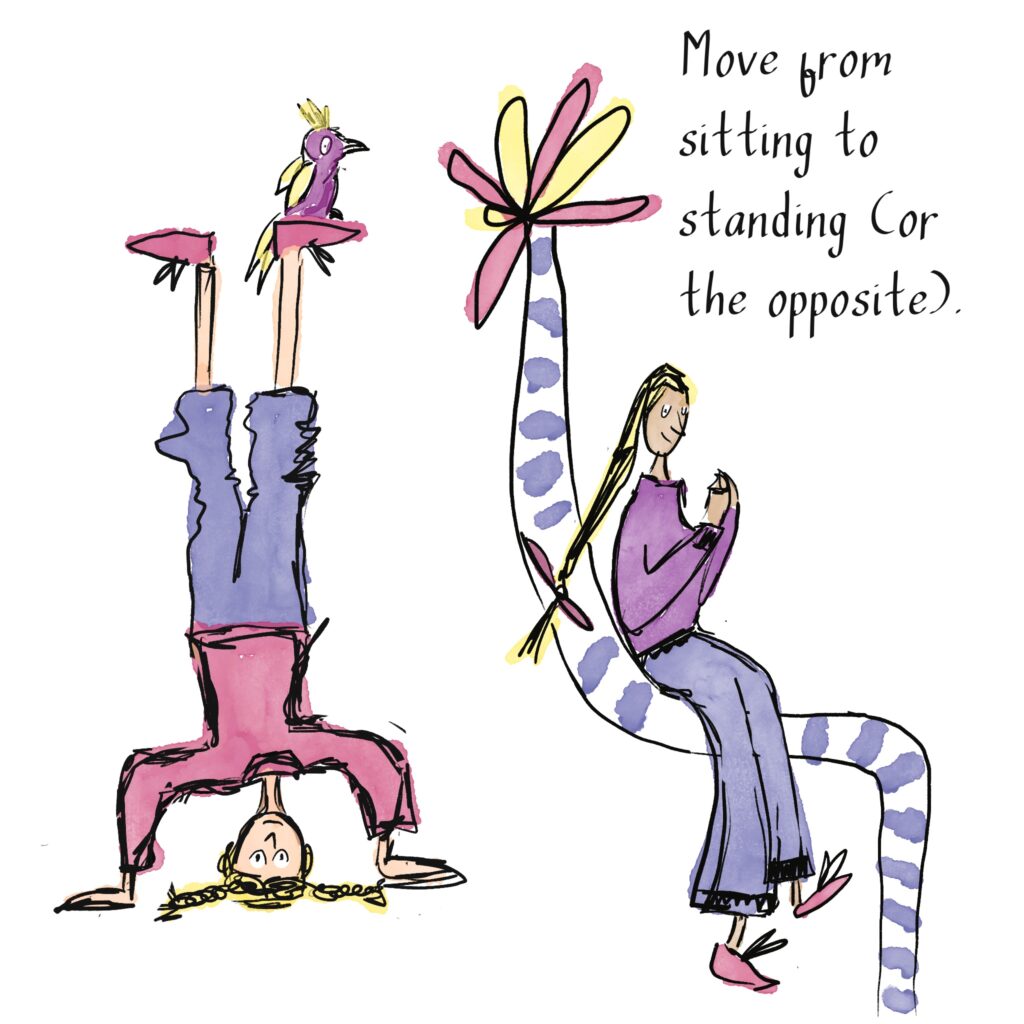
But you must be careful— Blah Blah energy is seductive. It’ll tell you not to move, that movement is impossible. I’m afraid you’ll need to give yourself a little shove (or get someone nearby to do it for you). But you need to move. Move in ways that are unexpected. Move differently. Make your body think. Make it wake up.

Do whatever you need to—but move. You need to redistribute that glitter.

A Small Experiment

Let’s tie this up in a neat little package, shall we? Finish the loop, as I often hear mentioned on Important Podcasts.

1. Ask yourself, Why are you doing this? Beyond everything out there. Because you want to is enough. It doesn’t have to be anything bigger than that. Our views around artistic permission are so strange. We convince ourselves if we aren’t making money or receiving rave reviews our art lacks validity and therefore we shouldn’t do it. That’s rubbish. Figure out what it means for you. End of.

2. Move. We are creatures of movement who find ourselves (more often than not) in a sedentary world. Novel movement reactivates your sensory system and helps pull you out of ground hog day patterns. You literally and metaphorically need to shake things up.

3. Commit to something highly practical. The brain loves functional process (it loathes being stranded on The Island of Overthinking) . Anything to far off the practical and functional can cause us to behave in wonky ways. Don’t worry if it’s good or bad, right or wrong. Focus on something technical, something learnable, something doable. And see what’s possible from there.

I’d love to hear your thoughts- what helps you navigate the Blah Blahs?

xx Jane

PS. A side note: If you are really chronically blah, it can legitimately mean that you’re exhausted. This is not the type of blah I’m meaning here- the one I am speaking to is more existential. There’s no cure for exhaustion but good sleep.

When Your Brain Is Like Scrambled Eggs (You Need To Make A List!)

I mean, let’s say hypothetically it’s Friday morning. Your head is feeling like scrambled eggs because you were up tending to global affairs with only two hours sleep, or because you were partying like it’s 1969, or in fact your teenage-something had a mini meltdown, combined with perimenopause fog detritus means that you have only a vague idea what your name is (I’ve purposely left this open ended so you have no idea which is me). You are aware that there are a mountain of things to be done, and you’d quite like to be placed in a sensory deprivation tank, possibly only drawing birds, but the world keeps prodding your pre-frontal cortex saying there are things that definitely need to get done.

At times like this, my friends, it’s important to hand over your executive function to other beings. And the being in my life right now is a great long list. And for an extra shot of dopamine, I recommend adding check boxes beside them so you can tick things off.

There’s nothing that will make a hormonal, feeling-like-the-bottom-of-a-pond-creature more accomplished than being able to add a big fat tick next to a thing that just got done.


Writing stuff down is, indeed, a magical thing. Those in the writing business know that we frequently understand ourselves better after, not before, the pen hits the page. That the purpose is not to arrive with the answers, but with all the many questions, and to hope, in some way, that we will scribe our way to the answers.


Lists are, perhaps, the most unromantic of all forms of writing, but they can still be a bloody good time. If you can’t be trusted to be left to your own devices for that day (week, month) then let a list take that gelatinous matter that used to be your brain and help you direct it usefully.


It helps you prioritise, reduce the overwhelm of all that bigness into tiny pockets of doable smallness, and stops you wondering about all the things you’ve forgotten while you sit around doing nothing.


It’s an exercise in simplification. In recognising the reality of where you are today, and turning the fuzz into action things. And the brain does love a bit of purpose. It’s entirely functional in its design. It hates it when you or I just stay up there, caught in overthinking.


So if that’s you (saving the world / hungover / caught in a hormonal rampage), may I suggest you make yourself a list. Take away the decision fatigue of your day and just tick off what needs to be done.


Sometimes, the things that are the most mundane will bring the most relief.


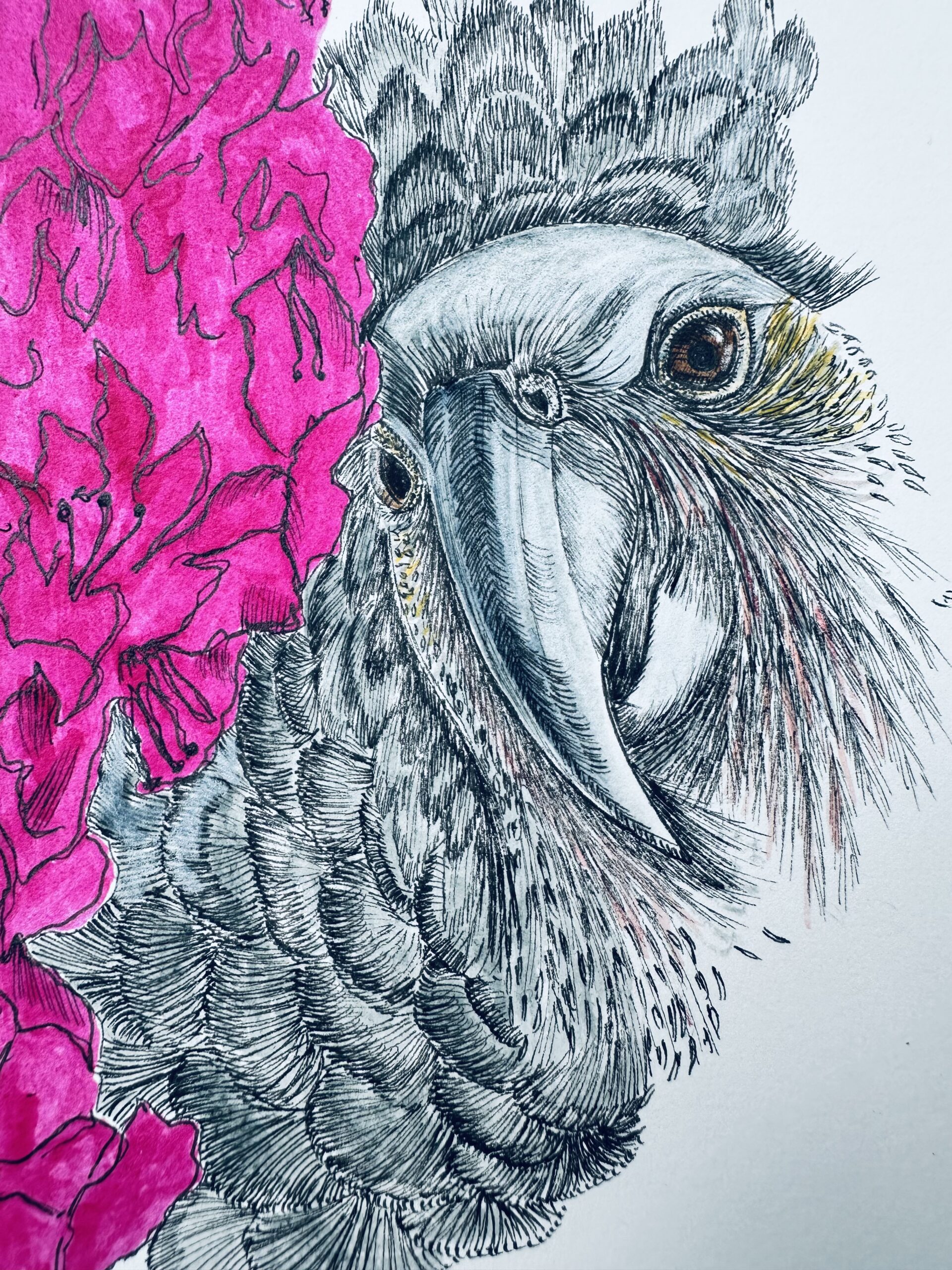
Last night’s beginning “Birds that visited my feeder” drawing, to keep me focused and less irritable at the kitchen table.

Remember, There’s No Need To Be Impressive.

When I was very young, I had a best friend named Carly, and she had a budgie named Roger, a little parakeet of yellow and gold, who lived in a very small cage. Roger was, as they say, born in captivity, so his sense of the world was equally small. And because it was the 80s, our understanding of what a bird (or any animal, really) might need was apparently quite small also.

Both being young, we thought loving Roger meant giving him his seed on time, cleaning out his cage, and pressing our probably-grubby-still-growing noses between the bars to tell him all about our day.

And perhaps, at that moment, Roger thought that was what freedom was too.

That all air was tinged with the faint smell of disinfectant, that wings only flapped for two seconds at a time, and that preening yourself was the most interesting part of a 24 hour cycle.

One fateful afternoon, Roger’s cage was sitting on the back deck when the weather turned windy. You can probably guess what happened next—we both watched it unfold in slow motion. The cage tipped over, the small door popped open on its way down, and Roger just sat there, stunned, staring at this opening with no hands to hold him back.

After what felt like forever, Roger moved toward the door and flew away.

Out into that wild, vast world.

Carly and I were devastated (I felt he was my bird as much as hers), but at the same time, we understood (or at least hoped) that maybe Roger was happier. Our tiny selves did have some understanding, after all, that birds were meant for bigger things than cages.

Can you imagine what that must have felt like? For Roger I mean?

Holy crap, I imagine him saying. This is wild! One can only hope he didn’t go completely off the rails.

I really hope he found his happy ending.

I wonder if he thought about a different form of freedom, or if he really thought there was none.

We do this all the time, us humans- convince ourselves of only one type of freedom.

This morning as I sat down to write. I was tired, grumpy even, and my brain felt completely devoid of inspiration. And when you get to that point, your mind can convince you that you’re in a little cage, where you play the same patterns, where you keep placing your attention on things which are upsetting and disturbing that keep you spinning around in the same old cycles of thought.

I don’t have a lot for you today, but the one thing I can share is that I do know it’s possible to open the door up of the cage.

That there are always different realities available to us than the one that feels the most present or familiar.

You can start by reminding yourself that there’s no need to be impressive. That you just need to do something, anything, to pull you out of the spin cycle and drop you back into your creative heart, your creative brain.

So I write. Badly and not that interestingly, but nonetheless with good intention.

I draw shapes that make no sense. I draw a lot of bad birds.

I talk to people doing interesting things, let myself ride the winds of their creative energy.

I talk to my mountain parrots who visit me and tell them I’ll fill up the nectar feeder soon.

They aren’t massive things, but they are reminders:

That we aren’t in a cage.

That we don’t belong to the abyss of bad news, no matter how much of it we’re fed.

And that what we make doesn’t have to be good.

That the fact we have mind to make it all it sometimes the only liberation that we need.

A drawing / painting from this week for you xx

Sprinting When You Are Designed To Walk

Sprinting when you are designed to walk…

I talked yesterday about seeking out more and more activities (art! all the making things!) that see you moving at a human pace, and today I thought I would share something super simple that helps you experience that in real time in a really practical way.

You’ll just need a pen, paper and 30 seconds.

Happy tinkering!

xx Jane

Moving At A Human Pace


Ok, so the first part is about avoiding maths…

But the second part is something I’ve recently become a little bit obsessed with: moving at a human pace.

So much of what we’re asked to do, and where we place our attention, has us moving out of sync with ourselves.

Phones have us absorbing information faster than we can assimilate it.

The culture we’re part of asks for outputs that don’t match our natural rhythms.

A lot of us are feeling a bit scrambled, out of sync, and (frankly) exhausted, all the stuff and all the things leaving us scattered mentally, physically, and emotionally.

Which is why making stuff — making all the lovely things — matters so much. Not just for the obvious reasons (paint all the birbs! Draw all the birbs!), but because it actually allows you to catch up with yourself.

It gathers all your scattered pieces and arranges them into something you recognise.

So if you’re looking for a reason to sit down this weekend and make some art, I can’t think of a better one than that.

Happy mark-making, my friends.

xx Jane

Focus On Finishing.

Don’t tell anyone this, but I used to be a massive nerd. I was the biggest, swottiest nerd you ever did see. I would hide away in my bedroom around exam time and study those books until the words were embossed on the back of my eye lids. And even then, it never felt like enough.

I cross trained in the highest form of energy a body can produce without chemical assistance: perfectionism and panic.

The other side of that was there was always, inevitably, a finish line. The exams had a date and would be over. I would have to stop, even if I didn’t want to.

And at that point, I remember being consumed by a lightness. My body lifted of its studious weights, I floated round, time seemingly swilling out before me like gossamer.

This is the joy of finishing energy. Of things being done. For my high school self, it never felt like I was ready for the end point to arrive. It always seemed like there was one more chapter I needed to read, or a quick thing I needed to check before I knew the answer to that question. But at some point, there was a forced surrender.

At some point, I needed to be done.

I think of this a lot in relationship to our creative work. There is a lot of focus on idea generation, on maintaining inspiration, but little emphasis on tying things up. Most people I work with aren’t short on ideas. But what they are short on is finishing energy. On picking that one thing and seeing it through.

Too many things left unfinished eat us alive. There’s a liberation in ending.

We leave things open and undone as a just in case policy. In case we can make it better. In case we think of a different way to end it.

What can you tie off, finish up?

What can you look and decide, yes, this is done?

What Is The Approach, When You Want To Close The Window Instead Of Fling It Open?

I’ve been thinking about what to write this morning since yesterday, and perhaps the day before, because the truth of the matter is, I’m feeling a little porous.

Like the spaces in between the edges of my skin have opened just enough for the world to creep in and the parts of me that are meant to be free and spacious are now heavy. A sodden towel needing to be wrung out placed in the full sun. This is my body for today.

What is the approach- to writing, to creating, to doing anything at all- when you want to close the window instead of fling them open, that instead of galloping you wish to crawl?

We accept this is the start point and begin.

We ride shotgun with the sadness or the heaviness or the anxiety or the fear, and we do not make requests of them at any point to disappear. We befriend them. Love on them. Make them hot chocolate. Treat them with care.

They are surprised at this approach and begin to soften their hard edges. We discover that they are searching for friendship as much as the next person (if we can be so audacious to presume an emotion is a person), and it’s only when we treat them kindly that we can really understand what they wanted in the first place.

We make it our mission to point out all the beauty, because beauty is a necessary thing. After all, if we are heavy with anything it is because we do not understand how others are missing all the beauty, so we best be making sure we are not missing it ourselves.

Speaking of which:

This weekend, I saw a Pīpipi, a brown creeper, for the very first time. Can you imagine? These adult eyes, in all their years of seeing, having never seen such a thing before. I was walking with a bird expert, and they pointed them out in amongst the trees, and I was wondrous like a child, enthusiastic and asking all the questions.

This is the way I think, through all the heaviness:

We take our soggy towel bodies, bundling everything they are holding and we tell them simply:

Just pay attention and keep looking in the trees.

This is the way to keep on going.

My drawing of the Pīpipi.